The Vegetarian Myth: Food, Justice, and Sustainability by Keith Lierre
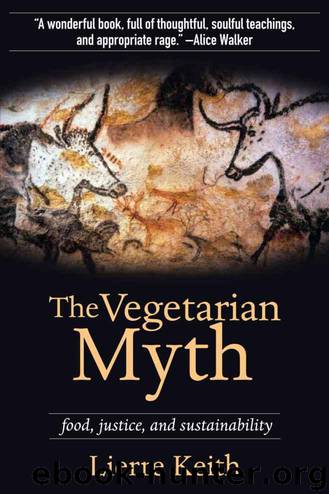
Author:Keith, Lierre [Keith, Lierre]
Language: eng
Format: mobi, epub
Publisher: PM Press
Published: 2009-04-30T16:00:00+00:00
And just as agriculture has displaced species-dense communities with its monocrops, its diet has displaced the nutrient-dense foods that humans need, replacing them with mononutrients of sugar and starch. This displacement led immediately to a drop in human stature as agriculture spread—the evidence couldn’t be clearer. The reasons are just as clear. Meat contains protein, minerals, and fats, fats that we need to metabolize those proteins and minerals. In contrast, grains are basically carbohydrates: what protein they do contain is low quality—lacking essential amino acids—and comes wrapped in indigestible fiber. Grains are essentially sugar with enough opioids to make them addictive.
The biological truth will be hard to face if, like me, you built the entire superstructure of your identity on a foundation of grain. But these are the facts. There are essential amino acids, the so-called building blocks of protein. They’re essential because humans can’t make them; we can only eat them. Likewise, there are essential fatty acids— fats—which, despite being vilified, can only be ingested, not made.
And carbohydrates? There is no such thing as a necessary carbohydrate. Read that again. Write the Drs. Eades, “the actual amount of carbohydrates required by humans for health is zero.”33
Every cell in your body can make all the sugar it needs. That includes the cells in your hungry brain. The detractors of low-carb diets have created and endlessly repeated the myth that our brains need glucose and hence we need to eat carbohydrates. Yes, our brains do need glucose—which is precisely why our bodies can make glucose. What the brain actually needs is a very steady supply of glucose: too much or too little will create a biological emergency that can result in coma and death, as any diabetic will tell you. And a constant cycle of too much/too little is exactly what a carbohydrate-based diet will provide, leaving a wreckage of deteriorating organs and arteries behind. A partial list of diseases caused by high insulin levels includes “heart disease, elevated cholesterol, elevated triglycerides, high blood pressure, blood clotting problems, colon cancer (and a number of other cancers), type II diabetes, gout, sleep apnea, obesity, iron-overload disease, gastroesophageal reflux (severe heartburn), peptic ulcer disease, [and] polycystic ovary disease.”34
These are serious diseases and they are endemic to civilized cultures. We accept them as normal because they are ubiquitous. We eat the foods our culture provides; we get sick. But then everyone is sick—who doesn’t know someone with diabetes, cancer, heart disease, arthritis?—so no one questions it. And it’s a lot to question, from the USDA food pyramid, to the righteous aura with which the Left has infused plant-based foods, to civilization itself. These are powerful forces to which our own native intelligence—both personal and cultural—has long been subordinated.
What we are left with are cravings, both vague and unbearable, that we have taught ourselves to fight. “When I eat, I feel full,” a friend of mine said. “But when I eat at your house, I feel nourished.” Believe me, it’s not my skill as a chef she’s acknowledging.
Download
The Vegetarian Myth: Food, Justice, and Sustainability by Keith Lierre.epub
This site does not store any files on its server. We only index and link to content provided by other sites. Please contact the content providers to delete copyright contents if any and email us, we'll remove relevant links or contents immediately.
International Integration of the Brazilian Economy by Elias C. Grivoyannis(111452)
The Radium Girls by Kate Moore(12118)
Turbulence by E. J. Noyes(8143)
Nudge - Improving Decisions about Health, Wealth, and Happiness by Thaler Sunstein(7774)
The Black Swan by Nassim Nicholas Taleb(7218)
Rich Dad Poor Dad by Robert T. Kiyosaki(6772)
Pioneering Portfolio Management by David F. Swensen(6354)
Man-made Catastrophes and Risk Information Concealment by Dmitry Chernov & Didier Sornette(6158)
Zero to One by Peter Thiel(5891)
Secrecy World by Jake Bernstein(4821)
Millionaire: The Philanderer, Gambler, and Duelist Who Invented Modern Finance by Janet Gleeson(4553)
The Age of Surveillance Capitalism by Shoshana Zuboff(4374)
Skin in the Game by Nassim Nicholas Taleb(4324)
The Money Culture by Michael Lewis(4273)
Bullshit Jobs by David Graeber(4267)
Skin in the Game: Hidden Asymmetries in Daily Life by Nassim Nicholas Taleb(4069)
The Dhandho Investor by Mohnish Pabrai(3838)
The Wisdom of Finance by Mihir Desai(3805)
Blockchain Basics by Daniel Drescher(3651)
